Technology is changing the way people interact with the digital world, and smart augmented reality (AR) glasses are emerging as one of the most exciting developments in wearable technology. The futuristic glasses shown in the image represent a concept of next-generation smart eyewear designed to combine augmented reality, artificial intelligence, cameras, voice controls, privacy features, and advanced batteries in a single wearable device.
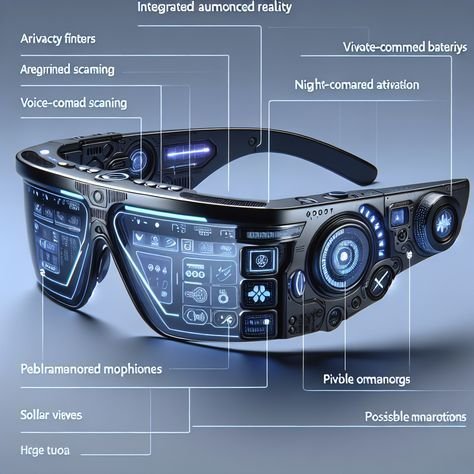
Unlike traditional glasses, smart AR glasses can potentially place digital information directly into the user’s field of view. Instead of constantly looking at a smartphone, users could access notifications, navigation, communication tools, entertainment, and AI-powered assistance while keeping their attention on the real world. Although the pictured device appears to be a futuristic concept rather than a confirmed commercial product, it provides an interesting look at what the future of smart eyewear could look like.
What Are Smart AR Glasses?
Smart AR glasses are wearable devices that combine the functions of traditional eyewear with digital technology. Depending on the design, they may include cameras, microphones, speakers, sensors, displays, wireless connectivity, and artificial intelligence.
The major difference between ordinary smart glasses and AR glasses is the ability to place digital content into the user’s view. For example, navigation directions could appear over a street, information about a location could be displayed while walking, or a virtual screen could appear in front of the wearer.
The concept shown in the image features an advanced, high-tech appearance with multiple cameras, electronic components, interface controls, and what appears to be an integrated display system. These elements suggest a device designed to deliver a highly interactive experience.
Integrated Augmented Reality
One of the most important potential features of future smart glasses is integrated augmented reality. AR can combine the physical environment with computer-generated information.
Imagine walking through a new city while digital arrows appear in front of you showing exactly where to turn. A traveler could potentially look at a building and receive information about it without opening a phone. In a professional environment, technicians could see digital instructions while repairing machinery.
AR glasses could also become useful in education. Students might explore a three-dimensional model of the human body, examine planets, or interact with historical environments while wearing the glasses. This could make learning more visual and interactive.
AI-Powered Assistance
Artificial intelligence could become another major part of future AR eyewear. Instead of simply displaying information, AI-powered glasses could understand voice commands and respond to questions.
A user might say, “What is the weather today?” or “Translate this sign,” and the glasses could potentially provide an answer through a visual display or audio. AI could also help users summarize information, identify objects, organize schedules, and assist with everyday tasks.
The combination of AI and AR could make smart glasses much more useful than conventional wearable devices. Rather than requiring users to search for information manually, an AI assistant could provide relevant information at the right moment.
Advanced Camera Systems
The concept in the image appears to feature multiple cameras positioned around the front and sides of the glasses. In a real-world product, cameras could serve several purposes.
They could capture photographs and videos, recognize visual information, support AR experiences, and help understand the surrounding environment. Multiple cameras could potentially provide better depth perception and environmental awareness.
For example, cameras and sensors could help determine where a user is looking or identify surfaces where virtual objects should appear. However, camera-equipped glasses also create important privacy concerns. Manufacturers would need to make recording indicators clear and provide strong privacy controls.
Voice-Controlled Technology
Voice control could make smart glasses easier to operate. Because the device is worn directly on the face, traditional buttons and touch controls may not always be convenient.
With built-in microphones, users could potentially perform tasks using simple voice commands. They could make calls, send messages, search for information, control music, or interact with an AI assistant without reaching for their phone.
Voice control could be especially valuable when users are driving, exercising, working, or carrying objects. Hands-free interaction is one of the strongest reasons why wearable technology continues to attract attention.
Privacy Features
Privacy is one of the most important challenges facing smart glasses. A device containing cameras and microphones can potentially record people, conversations, and surroundings.
Future smart glasses may therefore need advanced privacy features. These could include visible recording indicators, physical camera controls, permission systems, encrypted data, and settings that allow users to disable certain sensors.
Privacy filters could also become useful when displaying sensitive information. For example, financial details, private messages, or personal notifications should ideally be visible only to the wearer.
Developers will need to balance convenience with responsible technology design. Consumer trust will be essential for widespread adoption.
Battery Technology
Battery life is another major challenge for AR glasses. Cameras, displays, processors, wireless connections, and AI systems can consume significant amounts of energy.
The futuristic design shown in the image suggests a device built around compact battery technology. In practical products, manufacturers will need to make batteries powerful enough to support daily use while keeping the glasses lightweight and comfortable.
Future developments in battery chemistry, low-power processors, efficient displays, and smart power management could help improve battery life. Charging could potentially become faster and more convenient as the technology develops.
Applications in Everyday Life
Smart AR glasses could eventually be useful in many areas of everyday life. Navigation is an obvious example. Instead of checking a smartphone while walking, users could receive directions directly through their glasses.
Communication could also become more natural. Notifications and messages could appear without interrupting conversations. Video calls might potentially become more immersive through AR interfaces.
In the workplace, AR glasses could provide employees with real-time instructions, technical information, training materials, and remote assistance. Doctors, engineers, warehouse workers, designers, and emergency personnel could potentially benefit from hands-free access to information.
Entertainment is another major possibility. Users could watch virtual screens, play AR games, explore interactive environments, or experience new forms of digital storytelling.
Design and Comfort
Advanced technology is only useful if people are comfortable wearing it. Smart glasses must eventually become lightweight, durable, and attractive enough for everyday use.
The concept shown in the image has a highly futuristic design, featuring numerous visible components. However, commercial products may need a more streamlined appearance. Users are unlikely to wear a device every day if it feels heavy or uncomfortable.
Manufacturers will therefore face the challenge of fitting powerful processors, batteries, cameras, speakers, and displays into a small frame while maintaining a familiar glasses-like design.
The Future of Smart Eyewear
The future of smart AR glasses is likely to involve a combination of artificial intelligence, augmented reality, advanced sensors, improved cameras, wireless connectivity, and increasingly efficient batteries.
The technology still faces challenges, including cost, battery life, privacy, comfort, software development, and social acceptance. Nevertheless, the potential is enormous.
Smart glasses could eventually reduce our dependence on smartphones by moving many digital experiences from handheld screens directly into our surroundings. Instead of looking down at a screen, people could interact with information while remaining connected to the physical world.
Conclusion
The futuristic smart AR glasses shown in the image provide a fascinating vision of how wearable technology could evolve. Features such as augmented reality, AI assistance, cameras, voice controls, privacy systems, and advanced battery technology could transform the way people communicate, work, learn, travel, and enjoy entertainment.
While the specific design shown appears to be a futuristic concept rather than a confirmed product with verified specifications, the ideas behind it reflect real trends in technology. As processors become smaller, AI becomes more capable, displays become more efficient, and battery technology improves, smart glasses could become an increasingly important part of the digital ecosystem.
The ultimate goal of AR eyewear is not simply to put another screen on someone’s face. It is to create a more natural relationship between people and technology—one where useful digital information is available when needed without constantly pulling users away from the real world. If manufacturers can solve the challenges of privacy, comfort, battery life, and affordability, smart AR glasses may become one of the defining wearable technologies of the future.